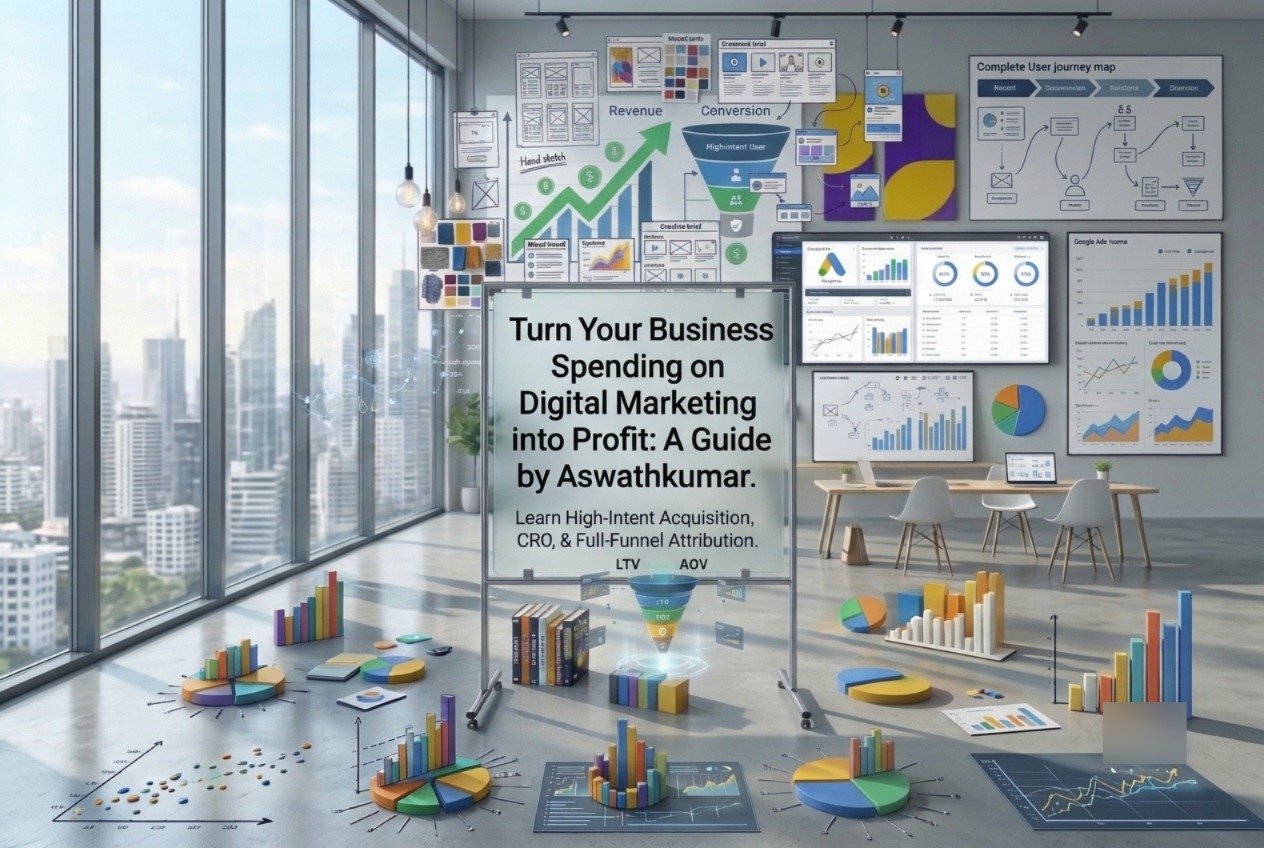
Marketing should never be a sunk cost. Every rupee or dollar spent on digital channels ought to act as an employee whose single job is to deliver qualified leads and measurable profit.
If your ad spend isn’t returning a profit, the issue rarely lies in the channels themselves; it lies in how your strategy connects spend to revenue.
Why Most Digital Marketing Spending Budget Fail to Drive ROI
Most brands struggle to generate direct profits from digital marketing due to three common pitfalls:
- Focusing on Vanity Metrics Over Revenue: Likes, impressions, and click-through rates (CTR) look great on paper, but they do not pay operational bills. High traffic without conversions is simply wasted bandwidth.
- Channel Silos: Running PPC ads without conversion rate optimization (CRO) or investing in local SEO without a solid lead-nurturing pipeline leads to leaked revenue.
- Lack of Full-Funnel Attribution: If you only track the final click, you miss out on understanding which touchpoints actually nurtured customer trust along the buyer’s journey.
“Digital marketing is not about spending money to gain attention; it is about engineering predictable acquisition systems where every marketing asset directly supports customer conversion.”
— Aswathkumar
4 Strategic Steps to Turn Digital Spending into Profit
To turn marketing expenses into predictable revenue, you need a disciplined framework focused on intent, conversion, and retention.
1. Shift from Broad Reach to High-Intent Targeting
Stop burning budget on generic, high-competition keywords that bring unqualified visitors. Focus instead on high-intent search terms and targeted audience segments that signal immediate buying need.
- Paid Search: Prioritize transactional keywords over broad informational queries.
- Organic Search (SEO): Build topical authority around core service lines rather than chasing empty traffic volume.
2. Optimize for Conversions First, Traffic Second
Driving 10,000 visitors to a poorly optimized landing page yields worse results than driving 1,000 targeted visitors to a page built for conversion.
Fix user experience (UX) roadblocks, speed up page load times, add trust signals (case studies, customer reviews, clear value propositions), and streamline call-to-action (CTA) paths before scaling ad budgets.
3. Implement Strict Conversion Tracking
If you cannot measure cost-per-acquisition (CPA) and customer lifetime value (LTV) accurately, you cannot optimize effectively. Ensure server-side tracking, Google Analytics 4 (GA4) event setups, and CRM integrations are aligned so every lead can be traced back to its traffic source.
4. Maximize Customer Lifetime Value (LTV)
Acquiring a new customer is up to five times more expensive than retaining an existing one. Combine search and paid acquisition with email automation, remarketing campaigns, and customer retention workflows to build long-term profitability.
Partnering with a Digital Marketing Consultant in Chennai for Sustainable Growth
Navigating performance marketing, search algorithms, and customer funnel optimization requires cross-channel expertise. Working alongside an experienced Digital Marketing Consultant in Chennai allows businesses to eliminate ad waste, build structured growth systems, and scale revenue with clarity.
“When marketing is treated as a strategic growth function rather than an ad-hoc experiment, campaign spending stops being a monthly overhead and starts operating as a scalable profit center.”
— Aswathkumar
Whether you run a B2B enterprise, a direct-to-consumer brand, or a local service business, turning marketing spending into profit comes down to systematic optimization, accurate data tracking, and customer-centric positioning.
Frequently Asked Questions (FAQs)
What is the difference between a digital marketing agency and a consultant?
An agency typically executes tactics across specific channels (e.g., social media posting, running ads). A digital marketing consultant focuses on business strategy, funnel optimization, tracking frameworks, and aligning your entire marketing spend directly with revenue and profit goals.
How long does it take to see profitable returns from digital marketing?
Paid campaigns (PPC) can generate qualified leads almost immediately once setup and tracking are complete. Search Engine Optimization (SEO) and content strategies usually require 3 to 6 months to build sustainable authority and organic lead generation.
How do I know if my current ad spend is being wasted?
If you are generating clicks and website visits but struggling with low lead volume, poor lead quality, high cost-per-lead (CPL), or unmapped conversions, your ad budget is likely being wasted on non-converting traffic.
Why is conversion rate optimization (CRO) important for profit?
CRO ensures a higher percentage of your existing web traffic turns into paying customers or leads. By improving conversion rates, you lower your customer acquisition costs without needing to increase your total advertising budget.
